

Affiliate disclosure: This article contains affiliate links. If you purchase through them, we may earn a commission at no additional cost to you. As an Amazon Associate I earn from qualifying purchases.
A round top and a few paper strips are enough to start an ocean character. These jellyfish crafts for kids use simple shapes and short broad paper tentacles, so you can spend more time creating and less time finding specialist supplies.
You will find seven variations, a practical setup guide and ways to turn the finished pictures into a shared ocean scene. Start with a crayon jellyfish if you want the quickest option. The closing plan helps you combine drawing, making and storytelling.
These are stylized art projects rather than accurate animal models. Children can choose imaginary colors and faces. The projects do not require long strings, loops or dangling decorations.
Use child-labeled supplies, read warnings and supervise closely. Let an adult handle cutting. Keep glue, caps and scraps out of mouths, then wash hands. See the CPSC craft safety guide.
Skip water beads for this activity. They can cause serious injury if swallowed and can be hard to find after a spill. The CPSC water beads information center explains the risks. Paper pictures work without a sensory-bin filler.
Set up jellyfish crafts for kids
Gather plain paper, a paper plate if needed, a suitable drawing tool and child-labeled glue. An adult can prepare a large semicircle and a few short wide paper strips. Keep the strips short and attach them flat to a background picture.
Draw facial details rather than using googly eyes. Keep the project at the table with direct supervision, and put it away afterward. It is not a toy to give an infant or leave in a sleep space.
Offer a small selection of colors. A child may choose purple and yellow, or use one color throughout. There is no need to copy the photo exactly. A broad shape that is easy to handle is more useful than a complicated outline.
1. Draw a jellyfish ocean picture
Draw a large curved top and connect it with a short line across the bottom. Add a few broad crayon lines below for tentacles. Your child can fill the background with their own ocean marks.
If drawing a curve feels frustrating, an adult can start the large outline and leave the colors to the child. One jellyfish is enough; a whole page of animals is not required.
2. Make a half-plate jellyfish
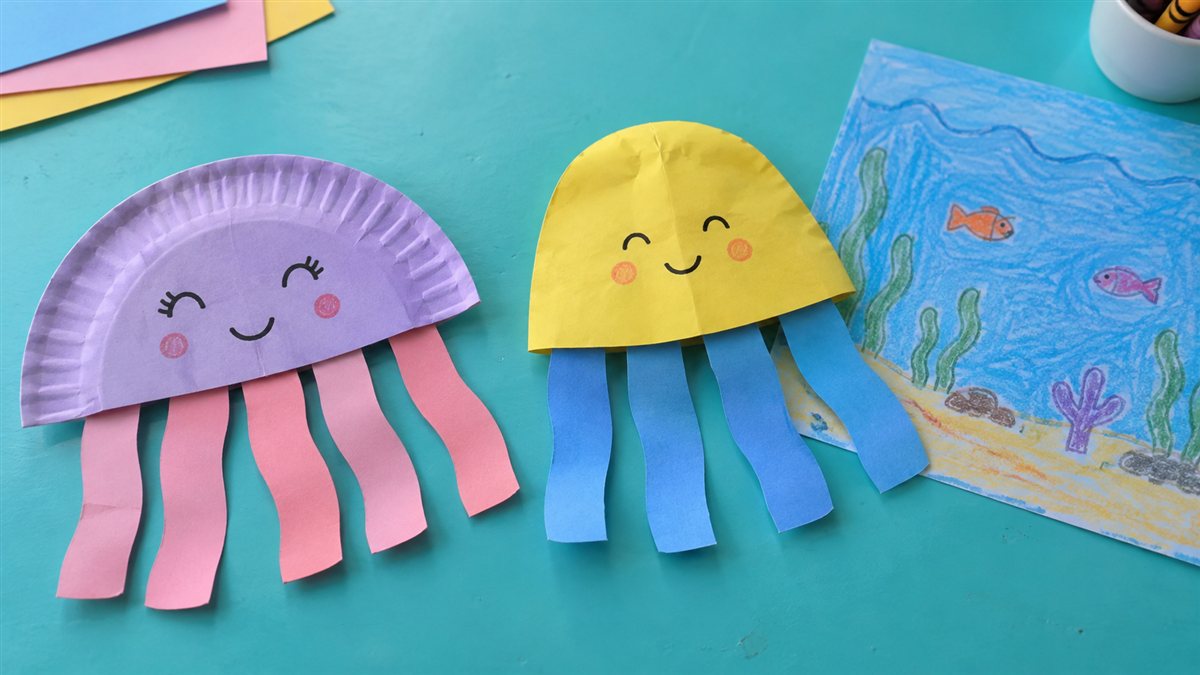
An adult cuts a paper plate in half. Decorate one half with a suitable drawing tool and position it on a background sheet. Add short broad paper tentacles beneath the straight edge and glue the pieces flat.
The plate gives the top a different texture from plain paper. If it curls or will not stay attached, place it on a flatter surface to dry or switch to a plain semicircle. Do not add extra fasteners simply to force the shape to hold.
3. Build a color-pattern jellyfish
Prepare a broad paper top and several short wide strips. Arrange the strips in a repeated color sequence, or let your child make any pattern they prefer. Attach them to the background before adding the top.
Talk about a color you notice rather than testing whether the sequence is correct. A child may deliberately break the pattern to add a favorite color. That can be part of the design.
4. Create a folded ocean card
Fold a card and draw a jellyfish on the front. Add a few short paper strips flat against the page if you want a collage version. Keep the design away from the crease.
Inside, write a greeting or a sentence your child dictates about their ocean creature. The card can go to a relative or become a title card for a collection of drawings.
5. Make a big-and-small jellyfish scene
Arrange one large paper jellyfish and one smaller one on the same sheet. Use a few short strips under each top. Leave enough space between them to see the different sizes.
Ask what the two characters are doing, if your child wants a story. They might be exploring a cave or looking for a friend. The scene does not need to make a claim about real jellyfish behavior.
6. Design a texture picture
Use crayon marks to give one jellyfish stripes, dots or broad loops within its top. Make a different texture in the background, such as curved lines for water. Keep all marks on the paper.
Try rubbing a crayon sideways on a spare sheet to see a broader stroke. Let the child choose the technique they like. Avoid adding loose beads or glitter to produce texture.
Give each participant one sheet for a jellyfish picture. After the projects are dry, arrange them together on a larger blue background. Add drawn sea plants or broad paper shapes around them.
This final project gives everyone an individual piece and a shared result. Invite each child to tell you where their jellyfish should go. Leave room for future pictures instead of filling the entire background at once.
Optional paper-craft supplies
Use suitable supplies you already have before buying more. The following examples serve different jobs: a paper base, an adhesive and a drawing tool. Check current package sizes and age instructions.
Assorted construction paper for folded books, flowers and cut-paper pictures. The observed bulk pack is 480 sheets in ten colors, 9 by 12 inches. Check whether this quantity fits your storage and choose smaller quantities if needed.


A paper-craft adhesive that goes on purple and dries clear. The observed pack includes three 22 gram sticks. Follow the label and supervise use; caps and glue are not play or food items.


Twelve extra jumbo crayons for drawing faces, story pictures and paper firework bursts. The observed listing describes a thicker format for kindergarten and primary-school use. Follow the actual age label, supervise coloring and remove broken pieces.


Keep the session manageable
Choose one project before setting out materials. A half-plate design involves adult preparation and drying time, while a crayon picture can begin immediately. Think about the help available today, rather than which version looks most elaborate.
Jellyfish crafts for kids can also be a quiet activity after looking at an ocean picture book. Ask your child which color or shape caught their attention, then use that as a starting point. You do not need to give a biology lesson to make the session worthwhile.
Let children stop before the picture feels finished to you. Save it flat if they want to return, then store the supplies safely. If they are more interested in making marks than assembling a jellyfish, offer a drawing page and let the craft plan go.
Make an ocean activity plan
-
Choose the method
Pick drawing for quick setup or a paper collage when an adult can prepare the pieces.
-
Create one character
Use a broad top and a few short strips or drawn tentacles.
-
Give it a setting
Add a background or place the finished picture in a shared paper ocean.
-
Share one idea
Ask what the child likes about their picture or what happens in their invented story.
Jellyfish craft questions
What are the simplest jellyfish crafts for kids?
A crayon ocean picture or a broad paper semicircle with a few short flat strips requires the least preparation. An adult can prepare the shapes if needed.
Do we need long ribbons or yarn tentacles?
No. Short wide paper strips attached flat to a background, or drawn lines, suit these projects without dangling strings or loops.
Can we make these without a paper plate?
Yes. Draw or prepare a semicircle from plain paper. Most of the ideas use paper alone.
Are these toys for babies?
No. They are supervised craft projects with paper and art supplies. Keep finished pieces and materials away from infants and sleep spaces.
Create a small ocean scene
- Use broad shapes.
- Keep tentacles short and flat.
- Finish with a setting or story.
Begin with one simple character and let the colors be your child’s choice. Jellyfish crafts for kids can become a picture, a card or a shared gallery without specialist materials.
Continue the paper theme with book crafts for kids. Topic inspiration: Maternity Comfort Solutions. This guide uses original project variations and wording rather than reproducing the source collection or its photographs.